← All comparisons

Comparison

CineoBoard vs Storyboarder.ai

Updated · 8 min read

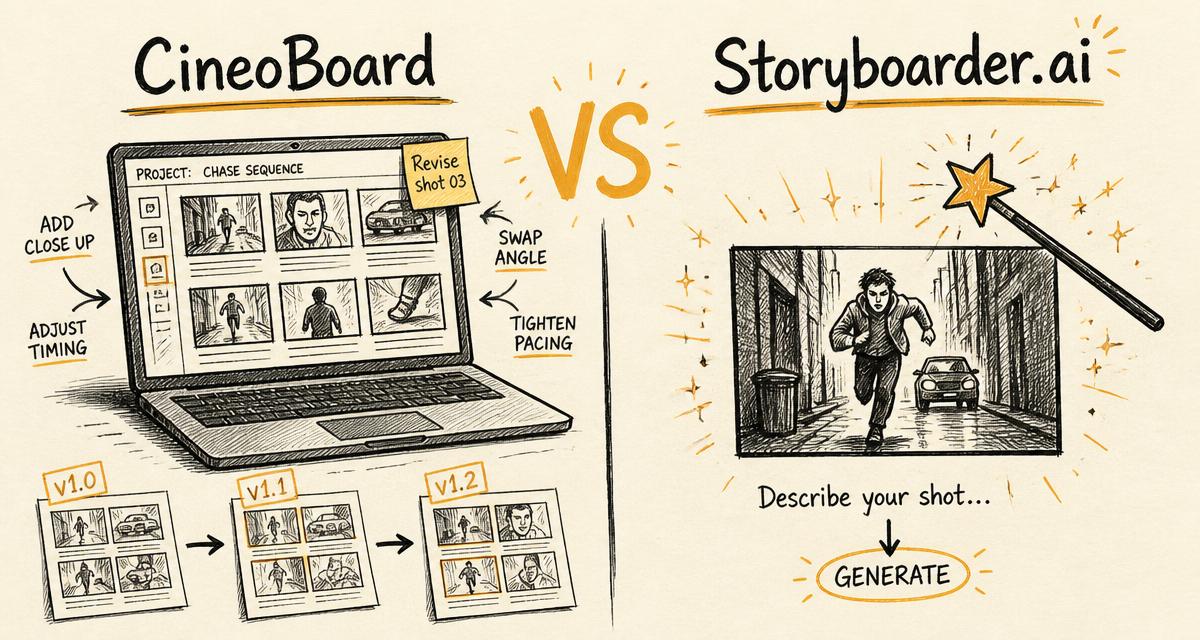
Hand-drawn storyboard-style cover comparing CineoBoard and Storyboarder.ai

Storyboarder.ai drafts a board from a script. CineoBoard breaks a script down too — then keeps the board alive with local-first editing, cloud project management, Slack and Teams, an agent API and an in-board assistant.

The verdict

Storyboarder.ai is strong at the first pass. CineoBoard is built for the eleven passes after it — the ones where a real production spends its money.

Storyboarder.ai: A pre-production platform that turns a script or idea into a screenplay, shot list, storyboard and animatic. Visit their site

Feature by feature

Feature comparison between CineoBoard and Storyboarder.ai
CapabilityCineoBoardStoryboarder.ai
Script import & auto scene splitYesYes
Script-to-beat frame breakdownYesYes
Reusable character / location libraryYesLimited
Local-first offline editingYes — ReframeNo
Project, scene & shot managementYesPartial
Slack / Microsoft TeamsYesNo
API / CLI for agent toolsYesNo
Assistant that edits the board in placeYesOne-shot output only
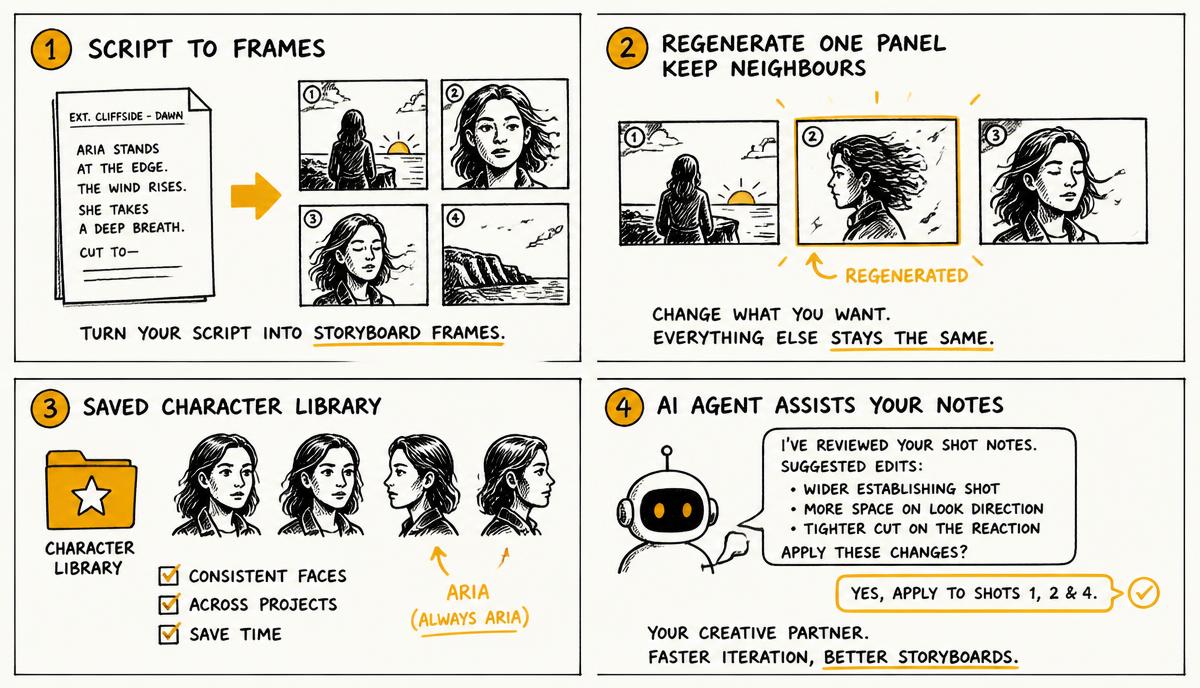
Hand-drawn panels showing a one-shot output versus an iterative, versioned board

The first pass is the cheap part

Turning a script into sixteen frames is now a solved commodity — several tools, including both of these, do it in a minute. The expensive part of pre-production is everything after: the director wants frame 7 tighter, the client wants the product bigger, legal wants the logo gone, and the shot list has to match all of it.

A one-shot tool hands you an output. CineoBoard hands you a document you can direct: rework one panel without disturbing the sequence, keep character and set design locked through a saved element library, and let the shot list, timing and PDF follow automatically.

An assistant, not a prompt box

The CineoBoard Assistant is closer to an Intercom-grade support agent than to a prompt field. It has context on the whole project — scenes, shots, durations, comments, versions — and it performs work: 'add reverse coverage to scene 3', 'flag every frame over 4 seconds', 'draft the client-facing summary of this revision'.

Because the same operations are exposed over an API and CLI, an external agent such as Codex can run them from your own pipeline: rebuild the board when the script changes in git, then post the new PDF to the channel.

The stack, in one line

CineoBoard is a local-first storyboarding app called Reframe paired with a cloud workspace for projects, scenes and shot management. Boards render and play back on your own machine, then sync to a shared project layer with Slack and Microsoft Teams notifications, an API and CLI that agentic coding tools such as Codex can drive, and an Intercom-grade CineoBoard Assistant that answers questions, edits and organises work inside the board.

Choose CineoBoard if

  • You will revise the board repeatedly with a client in the loop
  • You need frames to stay consistent across scenes via a saved element library
  • You want a tool that edits your board, not a black box that rebuilds it
  • You need offline editing and playback

Choose Storyboarder.ai if

  • You want a fast one-shot script-to-animatic demo
  • Nobody outside the room will review or revise the output

FAQs

Does CineoBoard break a script into frames too?

Yes. Drop in a Final Draft, Fountain or Word script and CineoBoard splits scenes and shots and lays out a first-pass frame for each beat.

Can I hand-correct first-pass frames?

That is the point of Reframe. Fix eyelines, blocking and camera notes locally, and swap rough characters for saved elements once the design is agreed.

Try CineoBoard on your next board

Local-first Reframe editing, cloud project and shot management, Slack and Teams, an agent-ready API and the CineoBoard Assistant. Plans from $30/month USD.

Get started