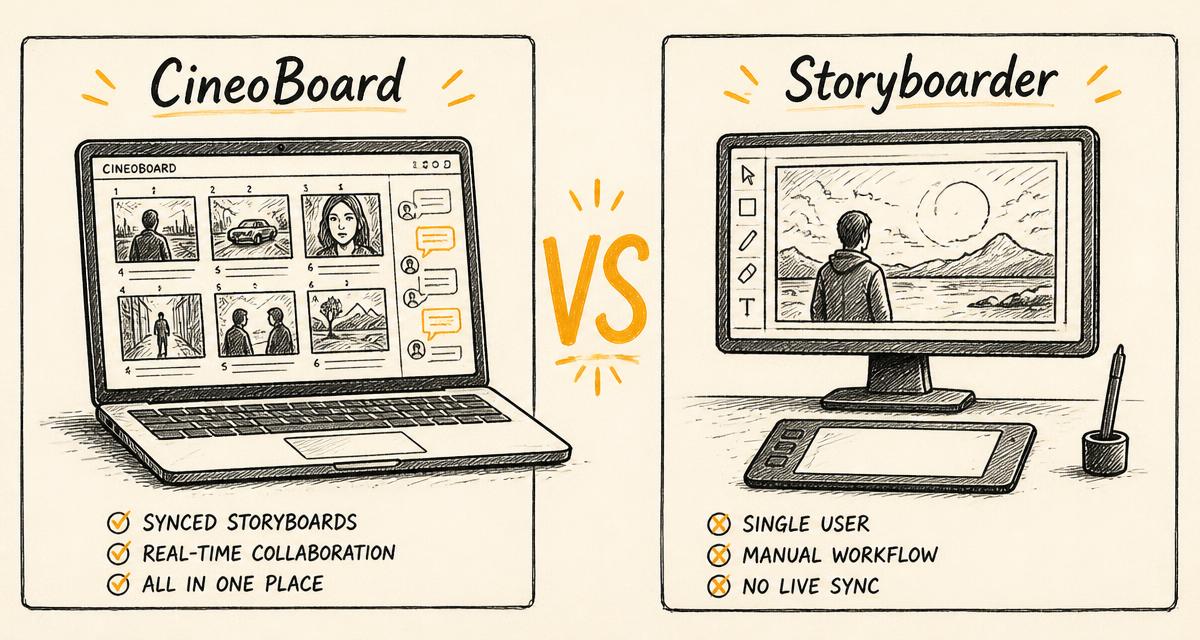
Two different definitions of 'storyboard tool'
Wonder Unit built Storyboarder to answer one question well: how fast can a director get an idea out of their head and onto a frame? It is a drawing surface with shot fields, it is free, and for solo sketching it is genuinely excellent.
CineoBoard answers a different question: how does a board stay true for the twelve people who depend on it? Think of it as Linear for pre-production, Dropbox-grade local sync, an agent interface in the shape of Codex, and Intercom-style assistance — wrapped around a storyboard editor.
Local-first is not the same as local-only
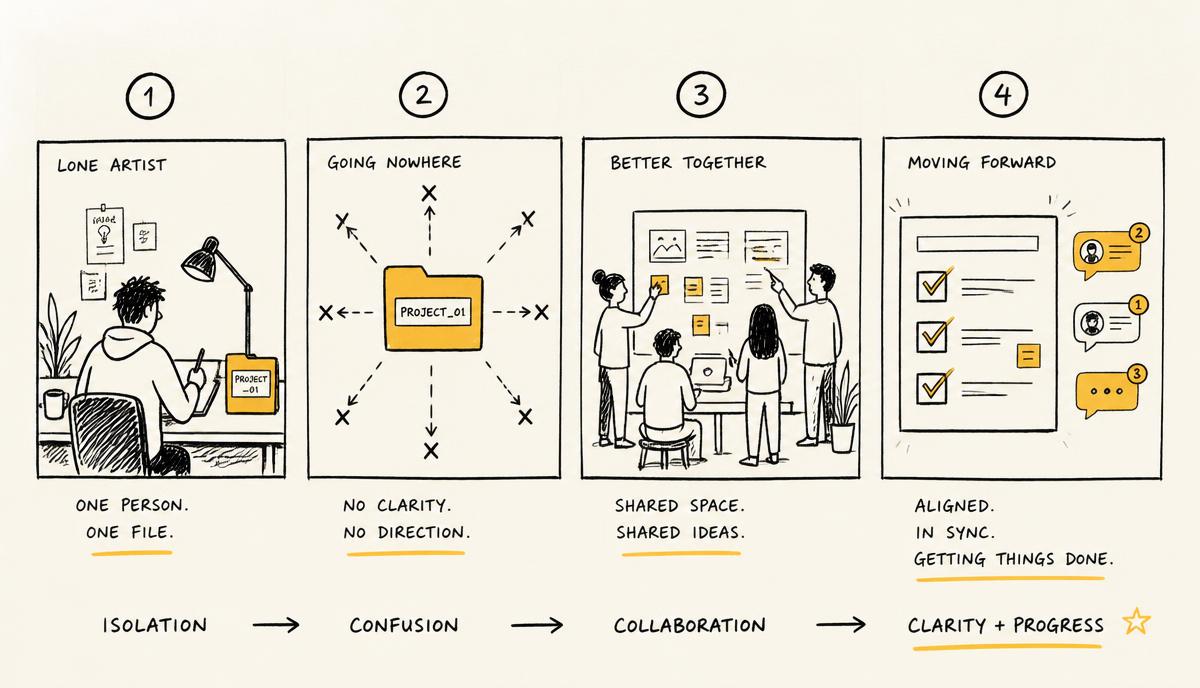
Storyboarder is local-only: the file lives on your disk and that is the end of the story. Share it and you are back to email attachments and filenames ending in _v7_final.
Reframe, the CineoBoard desktop app, is local-first. Every stroke, panel reorder and shot edit is written locally and rendered locally, so it never waits on a connection. The cloud layer then reconciles that work into a shared project with scene status, assignees, version history and review links.
- Draw and play back animatics offline with no spinner
- Reconnect and the project, scene and shot state merges automatically
- Version history you can roll back per frame, not per file
Where the crew actually lives
Boards do not get read inside boarding software; they get read in Slack, in Teams, and in a client's inbox. CineoBoard posts scene changes, comments and approvals into the channel the production already uses, and every frame carries a permanent link back into the board.
Storyboarder has no notion of a team channel, a reviewer or an approval state. That work moves to whatever chat and spreadsheet you bolt on beside it.
Automation and the in-board assistant
CineoBoard exposes projects, scenes, shots and exports through an API and CLI, so an agentic tool like Codex can assemble a board from a script commit, renumber a sequence or push a fresh PDF as part of a pipeline.
On top of that sits the CineoBoard Assistant, an Intercom-grade helper that lives in the board: ask it to split a scene into coverage, rewrite shot notes in the client's language, find every frame missing a duration, or produce the next revision — and it does the edit, not just the suggestion.